Flea and tick infestations inside residential structures escalate rapidly due to the reproductive rate of female fleas, which deposit up to 50 eggs per day into carpet fibers, hardwood gaps, and upholstered furniture.…
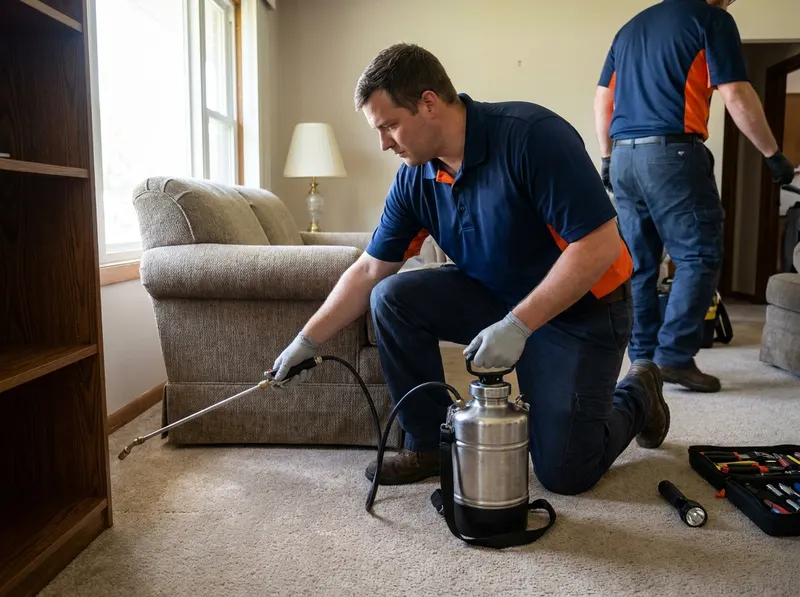
Flea and tick infestations inside residential structures escalate rapidly due to the reproductive rate of female fleas, which deposit up to 50 eggs per day into carpet fibers, hardwood gaps, and upholstered furniture. In established neighborhoods like Beaverdale and Sherman Hill, historic oak floorboards and high-pile area rugs trap emerging pupae that resist standard surface cleaning. Clinical interior remediation utilizes dual-action chemistries: a botanical or synthetic pyrethroid adulticide to neutralize jumping adults immediately, and an insect growth regulator (IGR) like pyriproxyfen to halt larval development and prevent viable molting. Properties bordering wooded ravines or river access points near Waterbury, Salisbury Oaks, and Gray's Lake Park face elevated tick migration from white-tailed deer and urban wildlife, introducing hard-bodied ticks into interior living spaces.
Decision-fit depends on the infestation vector. When domestic pets exhibit scratching or parasitic clusters appear in bedding, vacuum extraction alone fails because mechanical suction removes fewer than 20% of cocooned pupae. Chemical indoor remediation is the decisive action when bites appear on lower legs or parasites are visibly detected on upholstered furniture. The trade-off involves preparation rigor: homeowners must complete comprehensive floor clearing, vacuum all surfaces immediately prior to treatment, wash pet bedding at a minimum temperature of 130°F, and vacate the building alongside domestic animals for exactly 4 hours while liquid microencapsulated solutions dry to a clear, residue-free barrier.
Execution follows an objective, sequential protocol. First, technicians establish baseline perimeter boundaries, mapping high-risk harboring zones including baseboard channels, under-furniture voids, and HVAC register margins. Second, mechanical aerosolization disperses an insect growth regulator combined with a microencapsulated knock-down agent across 100% of exposed carpet, floor seams, and low-lying fabric substrates. Third, physical exclusion checks secure baseline exterior transitions to block reinfection paths. Occupants returning after the 4-hour dry window experience immediate reductions in biting frequency, though mechanical emergence of non-feeding pupae can persist for 10 to 14 days; residual IGR coatings neutralize these emerging adults upon contact before they achieve reproductive viability.
Every job gets a firm, written price after a free on-site visit.
Tell us about your flea & tick indoor remediation job in DesMoines and we'll send a clear, written quote, usually the same day.
 Dextaro Pest Response