Targeted rodent exclusion addresses the mechanical vulnerabilities of older Polk County residential builds, specifically the limestone basements in Sherman Hill, brick row foundations in East Village, and fieldstone…
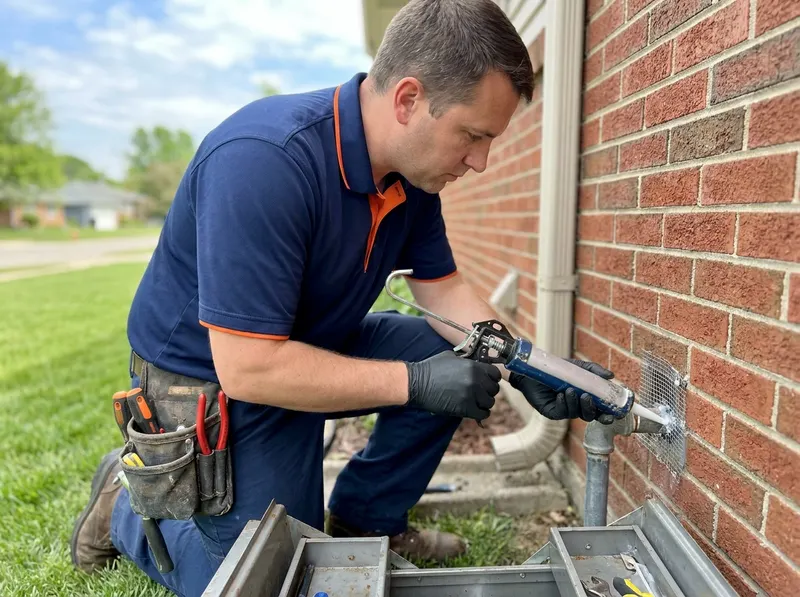
Targeted rodent exclusion addresses the mechanical vulnerabilities of older Polk County residential builds, specifically the limestone basements in Sherman Hill, brick row foundations in East Village, and fieldstone footings across Beaverdale. Commensal rodents exploit foundation settling cracks, crawlspace air vents, and loose utility conduits to penetrate conditioned interior spaces. A juvenile house mouse requires an opening of only 1/4-inch to compromise a wall assembly, while adult Norway rats penetrate gaps as narrow as 1/2-inch. Instead of relying on continuous monthly chemical subscription programs or indoor toxic bait formulations that risk pet exposure, exclusion permanently denies physical passage using chew-proof barrier materials. Copper packing mesh, 19-gauge galvanized steel mesh, and metal flashing prevent gnawing through wood trim and vinyl corner caps.
Decision-fit selection hinges on the structural state of the property. For buildings showing interior rodent activity along baseboards, exclusion pairs mechanical sealing with direct indoor trapping. If an active infestation exists inside attic insulation or hollow wall frames, internal traps capture the trapped population while the exterior perimeter defense stays closed. The structural trade-off involves prioritizing hard exterior closure over recurring poison boxes: mechanical exclusion requires an initial investment in metal fabrication and structural repairs, but it eliminates interior decaying carcass odors and removes the risk of poisoned rodents perishing inside inaccessible drywall voids.
Structural execution proceeds through distinct installation phases. 1. Technicians survey the entire perimeter from grade level to rooflines, checking crawlspace vents near Waterbury and low foundation penetrations along Ingersoll Park. 2. Field personnel measure and install heavy-gauge metal flashing over rotted wood fascias, basement sill plates, and garage door weatherstripping gaps. 3. Voids around HVAC lines, gas meters, plumbing stacks, and electrical meters receive high-density copper stuffing combined with elastomeric sealants. 4. Roof eaves, ridge caps, and architectural dormers in neighborhoods like Salisbury Oaks and Waveland Park receive fitted hardware cloth barriers that stop aerial entry from adjacent tree canopies.
Every job gets a firm, written price after a free on-site visit.
Tell us about your targeted rodent exclusion job in DesMoines and we'll send a clear, written quote, usually the same day.
 Dextaro Pest Response